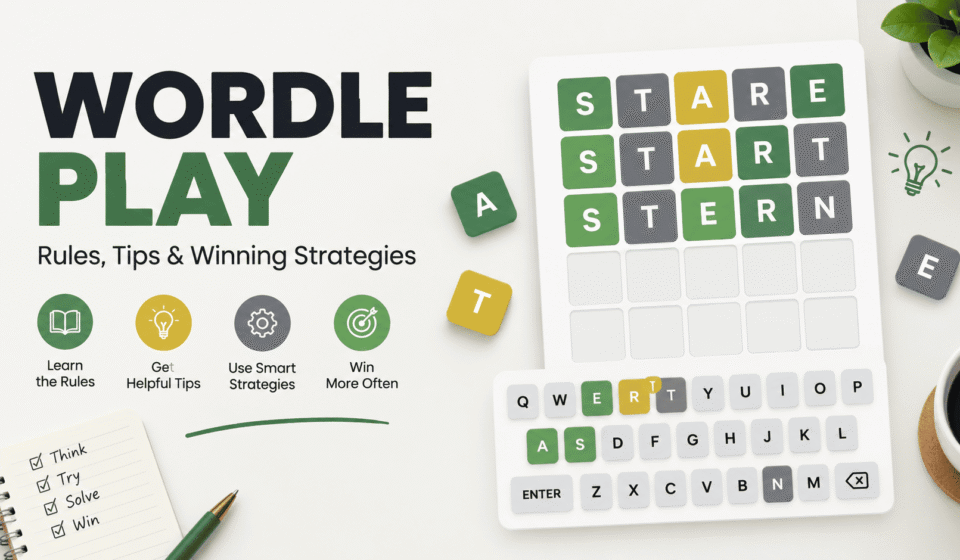

Wordle Play is a popular word puzzle that challenges players to discover a hidden five-letter word within six attempts. The game combines vocabulary, spelling, and logical reasoning in a simple format that is easy for beginners to understand. After every guess, colored tiles provide clues about which letters are correct, which appear in the wrong positions, and which are not part of the answer.
Although the rules are straightforward, solving Wordle consistently requires careful thinking. Players must use previous clues, recognize familiar word patterns, and choose guesses that help narrow down the possibilities.
Whether you are learning how to play Wordle for the first time or looking for practical ways to improve your results, this guide explains the rules, gameplay, color system, useful strategies, common mistakes, and frequently asked questions.
What Is Wordle Play?
Wordle is a word-guessing game in which players try to identify a hidden five-letter word. The standard version provides six attempts to find the correct answer. Each submitted guess produces color-coded feedback that helps players make more informed decisions.
The game became popular because it offers a short but engaging challenge without complicated controls or lengthy instructions. You do not need specialized knowledge to participate. A basic understanding of English words, spelling, and letter positions is enough to get started.
The phrase Wordle Play generally refers to playing the puzzle online, learning its rules, or finding strategies to solve it. The official version is available through The New York Times Games website.
One reason the game is engaging is that every guess can reveal something useful. A green tile confirms a letter’s position, a yellow tile identifies a misplaced letter, and a gray tile helps eliminate possibilities. By combining these clues, players gradually narrow the range of words that could be the answer.
Where Can You Play Wordle Online?
WORDLE PLAY
Guess the hidden five-letter word in six tries.
How to Play
Enter any five letters and submit your guess. You have six attempts to find the hidden word. The game does not require your guess to appear in a dictionary.
Green: The letter is correct and in the correct position.
Yellow: The letter appears in the hidden word but in another position.
Gray: The letter is not available in the hidden word, considering how many times that letter appears in the answer.
Use your physical keyboard or tap the on-screen letters. Press Enter to submit and Backspace to remove a letter.
How to Play Wordle Step by Step
Learning Wordle Play is simple once you understand the process of entering words and interpreting the clues.
Step 1: Open the Game
Visit the official Wordle page. You will see a grid with six rows and five spaces in each row. Each row represents one guess, and each space represents a letter.
You can normally enter letters using your device’s keyboard or the on-screen keyboard.
Step 2: Enter a Five-Letter Word
Choose an accepted five-letter word for your first guess. A useful starting word contains several common letters, giving you a chance to discover which letters might appear in the answer.
Examples include CRANE, SLATE, and TRACE. None guarantees a win, but each can test a combination of common consonants and vowels.
Step 3: Submit Your Guess
After entering the word, submit it. The game evaluates your guess and changes the tile colors according to the hidden answer.
Study the entire row rather than focusing on just one letter. Every tile contributes information.
Step 4: Use the Feedback
Keep green letters in their confirmed positions. Move yellow letters to different positions, and use gray feedback to eliminate unsuitable letters. Remember that repeated-letter rules can make some gray tiles more complicated to interpret.
Step 5: Make Another Guess
Choose a word that fits the clues you have collected. A good guess should help confirm possible letters, test new possibilities, or narrow down the remaining answers.
Step 6: Solve the Puzzle
Continue using the feedback until you discover the answer or use all six attempts. When all five letters turn green, you have successfully solved the puzzle.
Understanding Wordle Rules
The standard Wordle game follows a small set of rules that determine how each puzzle works.
| Rule | Explanation |
| Word length | The answer contains five letters. |
| Guess limit | Players have up to six attempts. |
| Valid guesses | Submitted words must be accepted by the game. |
| Color feedback | Tiles show whether letters are correctly positioned, misplaced, or absent. |
| Winning condition | Find the hidden word within six attempts. |
| Daily challenge | The official standard game provides a daily puzzle. |
A valid guess does not have to be the correct answer. You can submit a word simply to test letters and learn more about the hidden word.
For example, if your guess reveals that two letters are absent from the answer, you can avoid those letters in later attempts. This information may help you eliminate many possible words.
Wordle also permits repeated letters in its answers. A word may contain two copies of the same letter, so players should not assume that every answer uses five different letters.
What Do Green, Yellow, and Gray Tiles Mean?
Understanding the tile colors is essential to playing Wordle effectively.
Green: Correct Letter and Position
A green tile means that the letter belongs in the answer and is already in the correct position.
If the first letter of your guess turns green, you should normally keep that letter in the first position in subsequent guesses. Green feedback provides a confirmed part of the answer.
Yellow: Correct Letter, Wrong Position
A yellow tile means that the letter appears in the answer but is not in the position where you guessed it.
For example, if A turns yellow in the third position, you know that A belongs somewhere else in the answer. Your next guess should place it in a different position that remains possible.
Gray: Letter Not Present
A gray tile generally means that the letter does not appear in the answer. You can use this information to eliminate words containing that letter.
However, repeated letters require special attention. If a guess contains two copies of a letter but the answer contains only one, one copy may receive green or yellow feedback while the other receives gray feedback.
This does not necessarily mean the letter is absent altogether.
Combining the Clues
The most effective approach is to evaluate all the colors together. Preserve confirmed letters, reposition misplaced ones, and eliminate letters that are not available in the answer.
Then compare the remaining possibilities with familiar spelling patterns. This process turns each guess into a step toward a solution rather than an isolated attempt.
Wordle Play Example: Solving a Puzzle
Consider a puzzle in which the hidden answer is CRANE. The following example shows how feedback helps narrow down the possibilities.
First Guess: SLATE
Suppose you submit SLATE. The feedback is:
| Letter | Feedback | Meaning |
| S | Gray | S is absent from the answer. |
| L | Gray | L is absent from the answer. |
| A | Yellow | A is present but not in position three. |
| T | Gray | T is absent from the answer. |
| E | Green | E is correct in position five. |
You now know that A and E are present, with E fixed at the end. You can also eliminate S, L, and T.
Second Guess: CRATE
Next, you try CRATE. Against the answer CRANE, C, R, and A turn green, T turns gray, and E turns green.
This confirms the pattern C-R-A-_-E. Only the fourth letter remains unknown.
Third Guess: CRANE
You enter CRANE, and all five tiles turn green. The puzzle is solved in three attempts.
This example demonstrates how Wordle rewards the careful use of information. Each guess should help confirm letters, test positions, or reduce the number of possible answers.

Best Wordle Play Tips and Strategies
There is no starting word or technique that guarantees a win every time. However, several habits can make your guesses more effective.
1. Choose a Useful Starting Word
Start with a word that tests several common letters. CRANE, SLATE, and TRACE are examples worth trying.
The purpose of the first guess is to gather information. You do not have to solve the puzzle immediately; you need a useful starting point for later decisions.
2. Pay Attention to Vowels
A, E, I, O, and U can help reveal the structure of a word. Testing common vowels may make it easier to identify possible spelling patterns.
However, do not assume that every answer contains several different vowels. Some words repeat vowels, and others use less common combinations.
3. Test Common Consonants
Letters such as R, S, T, L, and N can be useful in opening guesses. Once some letters are confirmed, focus on testing the remaining possibilities rather than repeatedly using information you already know.
4. Make Every Guess Useful
Before submitting a word, consider what you expect to learn from it. Does it test an unknown letter? Does it fit the green and yellow clues? Could it distinguish between several possible answers?
Avoid guesses that repeat the same information without helping you narrow down the solution.
5. Track Excluded Letters
Remember which letters have received gray feedback. This can prevent you from choosing words that contain letters already ruled out.
Interpret duplicate letters carefully, because a gray copy may indicate that the answer contains fewer copies of that letter than your guess.
6. Look for Familiar Word Patterns
Common combinations such as CH, SH, TH, and ST can help you identify possible words. Familiar endings and spelling patterns can also provide useful clues.
Still, do not choose a word only because it looks familiar. It must fit all the feedback from your earlier guesses.
7. Check for Repeated Letters
If the clues do not seem to fit the words you are considering, think about whether the answer might contain repeated letters. This possibility can help explain unexpected gray feedback or eliminate incorrect assumptions.
8. Review Your Clues Before the Final Guess
Before using your last attempt, check every green position, yellow-letter restriction, and excluded letter. Consider the remaining possible answers and choose the one that best fits the evidence.
Taking a moment to review the board can prevent avoidable mistakes.
Common Wordle Mistakes to Avoid
Even experienced players sometimes lose puzzles by overlooking important clues. The following mistakes are worth avoiding:
- Ignoring previous feedback and repeating excluded letters.
- Placing a yellow letter in a position already shown to be incorrect.
- Moving green letters away from their confirmed positions.
- Forgetting that answers can contain repeated letters.
- Guessing random words without testing useful information.
- Assuming every five-letter word will be accepted.
- Rushing through the final attempts without checking the complete board.
A consistent approach is more reliable than random guessing. Review the clues, compare possible answers, and make sure each guess follows what the game has already revealed.
What Is Wordle Hard Mode?
Hard Mode is an optional setting in the official Wordle game that requires players to use revealed hints in subsequent guesses.
For example, if a letter turns green in the second position, later guesses must keep it there. If a letter turns yellow, later guesses must place it somewhere else.
This restriction encourages players to build their next guesses around confirmed information. It can also make some puzzles more challenging when several possible answers remain.
Standard mode provides more flexibility for testing other letters. Hard Mode requires you to respect the clues you have already received. Neither mode guarantees a win, so the choice depends on your preferred level of challenge.
Benefits of Playing Wordle
Wordle offers an enjoyable way to engage with words and patterns. The game encourages vocabulary exposure, spelling awareness, logical deduction, and the evaluation of possibilities.
It also provides a short daily activity that can be enjoyed during a break or shared with friends. Comparing results can create a friendly challenge without requiring players to reveal the answer.
These are potential benefits of the activities involved in playing Wordle, rather than guarantees of improved intelligence or long-term cognitive health.
Wordle and Other Word Games
If you enjoy Wordle, you may also like other online word puzzles. The New York Times Games collection includes Connections, which asks players to identify relationships between words, and Spelling Bee, which challenges players to create words from a set of letters.
Wordle differs because it focuses on identifying a hidden five-letter answer using color-coded clues within six attempts.
Other websites may provide Wordle-inspired games with unlimited puzzles, different word lengths, or alternative rules. Check each platform’s instructions to understand how its version works.
Conclusion
Wordle Play combines simple rules with a satisfying challenge of deduction. Players have six attempts to discover a hidden five-letter word by interpreting green, yellow, and gray tiles.
To improve, choose useful opening words, preserve confirmed letters, reposition yellow letters, track excluded letters, and consider repeated-letter possibilities. Most importantly, make every guess count by using the information already available.
Whether you are new to the game or looking to improve your daily results, understanding these rules and strategies can help you approach Wordle with greater confidence and enjoy each puzzle as a fresh word challenge.
Frequently Asked Questions About Wordle Play
1. What Is Wordle Play?
Wordle Play refers to playing the Wordle word-guessing game online. Players try to identify a hidden five-letter word within six guesses by using color-coded feedback.
2. How Do You Play Wordle Online?
Open the official Wordle game, enter an accepted five-letter word, submit your guess, and study the tile colors. Use those clues to improve your next guess until you solve the puzzle or use all six attempts.
3. Is Wordle Free to Play?
The standard daily Wordle game is available through The New York Times Games platform. Access to additional games and certain features may vary according to current platform policies.
4. How Many Guesses Do You Get in Wordle?
The standard game allows up to six guesses. After each attempt, the colored tiles provide information about the hidden word.
5. What Is the Best Starting Word for Wordle?
There is no universally best starting word. CRANE, SLATE, and TRACE are useful options because they test several common letters, but your results depend on how you use the clues.
6. Can You Play Wordle More Than Once a Day?
The official standard game provides one new daily puzzle. Some alternative platforms offer practice modes, archives, or additional puzzles, depending on their features and rules.



[…] Wordle Play: How to Play, Rules, Tips, and Strategies to Win […]