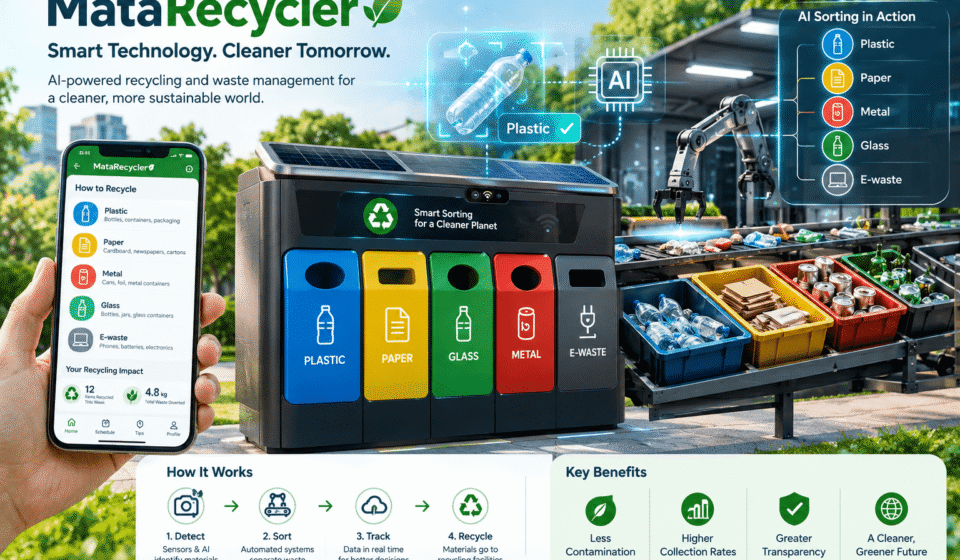

MataRecycler is described as a smart recycling system designed to improve waste sorting and material recovery using technologies such as artificial intelligence (AI), sensors, automation, and data analytics. Its main goal is to separate materials like plastic, paper, cardboard, glass, and metals more efficiently, helping reduce contamination and simplify recycling.
Traditional recycling often relies on manual sorting and mechanical equipment, while smart recycling technology can identify materials, monitor bin levels, and support automated collection. However, these are general examples of smart recycling capabilities, and it has not been confirmed that every feature is available in a specific MataRecycler product.
How Does MataRecycler Work?
The process associated with it can be understood through the main stages of a smart recycling workflow. The exact configuration depends on the equipment and software used.
1. Waste Collection and Detection
Waste enters a collection bin or sorting facility. Depending on the system, cameras, sensors, weighing equipment, or other devices may inspect the waste.
Smart bins can monitor their capacity, while industrial systems may examine individual items moving through a sorting line.
2. AI-Based Material Identification
Artificial intelligence can analyze information from cameras and sensors to classify materials. Computer vision systems examine characteristics such as shape, colour, size, and texture.
This technology may help identify plastic bottles, cardboard packaging, glass containers, and metal cans. However, visually similar materials can be difficult to distinguish, and mixed packaging may require specialized sensors.
3. Automated Waste Sorting with MataRecycler
After identification, mechanical equipment can direct materials into separate collection streams. Depending on the facility, this may involve conveyors, magnets, optical sorters, air jets, or robotic arms.
Automation can reduce repetitive manual work and help facilities process large quantities of waste. However, the results depend on equipment quality, maintenance, and the condition of the materials.
4. Data Monitoring and Material Recovery
Connected systems can record waste volumes, bin capacity, collection activity, and sorting performance. This information may help operators improve collection schedules and identify recurring problems.
After sorting, suitable materials are transported to appropriate recycling facilities for cleaning, processing, and reuse. Sorting alone does not guarantee recycling; recovered materials must still be accepted and processed by a suitable facility.
Key Features of MataRecycler and Its Related Technologies
Online descriptions associate it with several technologies used in modern waste management. Their availability as specific MataRecycler features has not been independently established.
AI-Powered Waste Recognition
AI systems can identify and classify waste by comparing its characteristics with patterns learned from training data. This can improve consistency when handling large volumes of similar materials.
Nevertheless, contaminated, damaged, or unfamiliar items may be misclassified. AI sorting requires appropriate training data, testing, and ongoing maintenance.
Smart Sensors and IoT Connectivity
Smart sensors can monitor bin capacity, weight, and equipment conditions. Internet of Things (IoT) technology allows connected devices to transmit this information to a central monitoring platform.
Collection teams can use these updates to identify bins that need attention and monitor equipment across different locations. Reliable connectivity and properly maintained devices are essential.
Real-Time Analytics and Digital Dashboards
Waste management dashboards can display information such as collected waste volumes, recycling rates, contamination observations, and collection frequency.
Businesses may use these reports to identify waste reduction opportunities, while municipalities can study collection patterns and improve public services. Reliable results depend on accurate measurements and consistent reporting.
Mobile Recycling Guidance
Some descriptions present MataRecycler as a mobile recycling assistant that offers sorting instructions, reminders, and collection information.
An app with these functions could help people understand local recycling rules and prepare materials correctly. However, it official app availability and specific mobile features have not been confirmed.
Automated Collection and Route Planning
Smart waste systems can use bin-capacity data and historical records to prioritize collection stops. This may reduce unnecessary trips and help prevent overflowing bins.
Actual improvements depend on traffic, vehicle capacity, collection schedules, and the accuracy of the information available.
What Types of Waste Can MataRecycler Potentially Handle?
Available descriptions associate MataRecycler with several common waste categories, although a verified official list of supported materials is not available.
- Plastic and packaging: Materials such as PET bottles and HDPE containers may be identified and separated. Labels, food residue, and mixed packaging can complicate classification.
- Paper and cardboard: These materials are commonly recycled when they are clean and suitable for processing. Moisture and grease can reduce their recyclability.
- Glass and metals: Glass containers, aluminium, and steel require appropriate separation methods and processing facilities.
- Electronic waste: Discarded electronic devices may contain valuable materials but require specialized collection and treatment.
- Organic waste: Food scraps and garden waste may be suitable for composting or anaerobic digestion, depending on local facilities.
- Composite materials: Multilayer packaging and certain biodegradable materials can be difficult to identify and process correctly.
The ability to recognize an item does not automatically mean that it can be recycled. Local recycling rules, available equipment, and processing facilities determine which materials can be accepted.
Benefits of MataRecycler for Waste Management
The potential benefits of MataRecycler reflect the broader advantages of intelligent recycling systems. Actual results depend on implementation and should not be assumed without supporting evidence.
Improved Sorting Accuracy
Automated identification can help separate materials more consistently and reduce some errors associated with manual sorting. Its effectiveness depends on the waste stream, sensor quality, and system design.
Reduced Recycling Contamination
Contamination occurs when unsuitable materials enter a recycling stream. AI-assisted identification and appropriate sorting equipment may help detect incorrect items before further processing.
Cleaner material streams can be easier to process, but automation cannot eliminate every contamination problem. Clear instructions and public participation remain important.
More Efficient Collection
Connected sensors can show when bins approach capacity. Collection teams can use this information to prioritize locations instead of relying entirely on fixed schedules.
This approach may reduce unnecessary journeys, fuel use, and overflowing bins, although the results vary by location.
Better Waste Tracking by MataRecycler
Digital records can help organizations understand how much waste they produce and identify the materials responsible for the largest volumes.
These insights can support purchasing decisions, recycling programs, and sustainability reporting. Reliable data collection is essential for meaningful comparisons.
Resource Recovery and Environmental Support
Effective sorting can help recover suitable plastics, metals, paper, and glass for reuse in manufacturing. This supports resource conservation and circular economy practices.
Smart collection systems may also reduce unnecessary transportation. However, recycling outcomes depend on suitable processing facilities and actual demand for recovered materials.
Practical Applications of MataRecycler
Smart recycling technologies can be useful across different sectors, although specific MataRecycler installations have not been independently confirmed.
Homes and Residential Communities
Smart bins and clear sorting guidance could help residents separate waste correctly. Connected monitoring may also help property managers identify overflowing containers and improve collection schedules.
Businesses and Commercial Buildings
Offices, hotels, restaurants, and retailers produce different types of waste. Digital tracking can help businesses monitor packaging, paper, and other material streams while identifying opportunities to reduce waste.
Waste records may also support sustainability reporting, provided the information is measured accurately.
MataRecycler in Schools and Universities
Educational institutions can combine recycling facilities with practical environmental education. Clear labels, sorting demonstrations, and waste reports can help students understand responsible disposal.
Recycling Facilities and Industrial Operations
Large facilities may use AI recognition, conveyors, optical sorters, and robotics to process substantial quantities of waste. The appropriate technology depends on the materials handled and the facility’s processing requirements.
Municipal Services and Smart Cities
Municipal authorities can use connected bins and collection data to identify areas with high waste volumes, prevent overflowing public containers, and improve route planning.
These applications illustrate the potential of smart recycling. They should not be treated as proof that it currently serves each sector.
MataRecycler vs. Traditional Recycling Systems
Smart recycling usually supplements traditional waste management rather than replacing it entirely.
| Feature | Traditional recycling | Smart recycling approach |
| Material identification | Manual and mechanical methods | May use AI and sensors |
| Sorting | Manual or machine-assisted | May include automated classification |
| Bin monitoring | Periodic checks or fixed schedules | May use connected sensors |
| Waste reporting | Manual records or basic systems | May provide digital dashboards |
| Collection planning | Predetermined routes | May use real-time capacity data |
| Initial costs | Depend on existing facilities | Additional equipment may increase costs |
| Maintenance | Depends on equipment | May require software and sensor maintenance |
Smart technology can improve specific processes, but it does not automatically make every recycling operation more effective. Performance depends on infrastructure, waste composition, staff training, operating costs, and maintenance.
Challenges and Limitations of MataRecycler
Despite the potential advantages of smart recycling, several challenges can affect its implementation.
High Installation Costs
Smart bins, cameras, sensors, automated sorting equipment, and software can require significant upfront investment. Organizations must also consider training, energy use, repairs, and replacement costs.
Maintenance and Technical Requirements
Sensors can fail, cameras may become obstructed, and mechanical equipment can wear out. Reliable operations require regular maintenance, software updates, and appropriate technical support.
AI Errors and Difficult Materials of MataRecycler
Mixed packaging, dirty waste, damaged products, and unfamiliar materials can be difficult to identify. Some items require specialized detection methods or manual inspection.
Infrastructure and Connectivity
Connected systems may depend on reliable power, internet access, collection vehicles, and suitable recycling facilities. Technology cannot compensate for missing processing infrastructure.
Public Participation
People still need convenient collection services and clear recycling instructions. Education and responsible disposal practices remain important even when automated equipment is available.
Uncertainty About MataRecycler
The available information does not clearly establish it ownership, official specifications, pricing, confirmed availability, or independently verified performance. Potential buyers should verify these details before making purchasing decisions.
Is MataRecycler a Real Product or a Smart Recycling Concept?
This question is important because online descriptions do not consistently explain what it actually is.
Some sources describe it as a physical recycling system featuring AI, smart bins, sensors, and automated sorting. Others present it as a mobile assistant offering recycling guidance and reminders.
The technologies mentioned are used in the broader recycling industry. However, their existence does not prove that MataRecycler is one commercial product offering all these functions.
The available material does not establish a verified company profile, complete technical specifications, official pricing, confirmed mobile application, or independently documented customer deployments.
Readers should look for official product documentation, identifiable company information, clear compatibility details, and credible case studies before relying on specific claims.
Until stronger evidence becomes available, it is most accurate to describe MataRecycler as a reported smart recycling concept or system rather than a fully verified commercial platform.
Environmental Impact of Smart Recycling
Smart recycling can contribute to environmental improvement when materials are collected properly, separated effectively, and sent to suitable processing facilities.
Recovering useful materials can reduce landfill disposal and demand for certain virgin resources. Better collection planning may also reduce unnecessary vehicle journeys and associated emissions.
However, environmental benefits vary by material and processing method. Collection and recycling also consume energy and resources, so the complete lifecycle matters.
The circular economy extends beyond recycling. Reducing unnecessary purchases, repairing products, reusing materials, and choosing durable goods can prevent waste before it enters the disposal system.
Smart recycling works best as part of a broader waste reduction strategy rather than as a standalone solution.
What Is the Future of MataRecycler?
MataRecycler’s specific development plans have not been confirmed, but the wider smart recycling industry is advancing in several areas.
Improved AI recognition: Better computer vision and machine learning may help systems identify more packaging types and unfamiliar materials.
Robotic sorting: Advanced robotics may improve processing speed and handle repetitive sorting tasks in large facilities.
Predictive collection: Historical records and sensor data may help operators forecast when bins will need collection.
Connected infrastructure: Smart waste systems may increasingly connect with energy management, municipal services, and other environmental monitoring tools.
Better recycling transparency: Digital records may help organizations track collected materials and assess the performance of recycling programs.
These developments represent possible directions for intelligent recycling technology, not confirmed future features of MataRecycler. Their success will depend on affordability, technical reliability, and practical environmental value.
FAQs About MataRecycler
1. What is MataRecycler?
It is described online as a smart recycling and waste management concept associated with AI-assisted material identification, sensors, automation, and data analytics. Its exact commercial status and complete feature set remain unverified.
2. How does it work?
The described process involves collecting waste, identifying materials through cameras or sensors, sorting suitable items, and monitoring operational data. The exact configuration attributed to MataRecycler has not been independently confirmed.
3. What materials can identify?
Descriptions mention plastic, paper, cardboard, glass, metals, electronic waste, organic waste, and composite packaging. However, no verified official compatibility list has been identified.
4. Is it available as a mobile app?
One source describes an app-based recycling assistant, but an official application and its availability on Android, iOS, or the web have not been confirmed.
5. Can it reduce recycling contamination?
AI-assisted identification may help reduce sorting errors when properly implemented. Actual results depend on equitment quality, waste conditions, and local recycling rules. Its specific performance has not been independently established.
6. What are the main limitations of MataRecycler?
Potential limitations include equipment costs, maintenance requirements, AI errors, infrastructure needs, and dependence on suitable recycling facilities. Its ownership, pricing, and verified deployments also remain unclear.
Conclusion
It is described as a smart recycling concept that connects AI-assisted identification, sensors, automation, and digital analytics with the goal of improving waste management. These technologies can support better sorting, more efficient collection, and improved material recovery when properly implemented.
Its potential applications span homes, businesses, schools, recycling facilities, and municipal services. However, successful recycling also requires suitable infrastructure, public participation, reliable maintenance, and facilities capable of processing recovered materials.
The distinction between general smart recycling technology and MataRecycler’s specific capabilities remains important. Official documentation and credible performance evidence are needed to establish exactly what the platform offers.
Ultimately, intelligent recycling can contribute to a cleaner and more resource-efficient future when combined with waste prevention, reuse, responsible consumption, and effective recycling services.

[…] MataRecycler: Smart Recycling Technology, How It Works, and Its Future […]