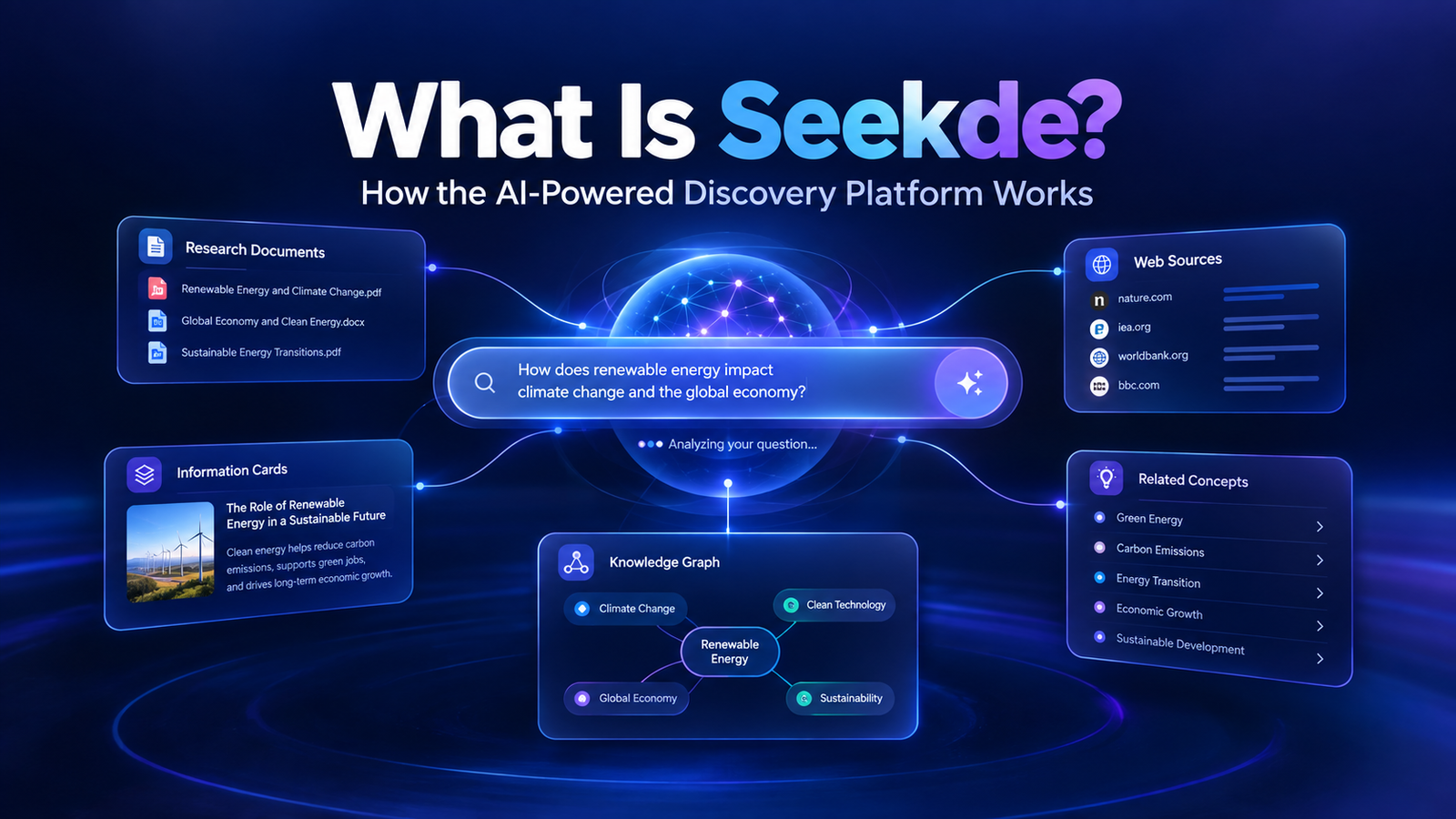

Seekde is an emerging digital discovery and AI-assisted search platform focused on helping users find and explore information in a more contextual way.
Traditional search generally starts with a query and returns a collection of webpages, documents, images, videos, or other results. The user then decides which results matter, compares them, and connects information from different sources.
Seekde presents a different concept. Its stated goal is to make discovery more organized by paying attention to the intent and context behind a search.
For example, consider the query:
“Best CRM software for a solo agency with three clients and a limited budget.”
The important information is not just the words “CRM software.” The user has also provided a business situation, team size, number of clients, and a budget constraint. An intent-oriented system can use those details when organizing information.
The broader idea is to move from:
Search → Links → Manual research
toward:
Question → Intent → Context → Related information → Deeper exploration
Seekde is therefore better understood as a discovery-oriented approach to search rather than simply another conventional search box.
What Does Seekde Mean?
Seekde is not a traditional dictionary word with one universally established definition. The name is commonly associated with ideas such as seeking information, knowledge, discovery, and intelligent information retrieval.
In the context of the platform, the concept of “seeking” is relevant because the service is designed around exploring information rather than simply locating an individual webpage.
The exact origin or meaning of the name should not be overstated unless it is directly documented by the platform. Online descriptions may explain the name differently, and several websites using the Seekde name can make the terminology confusing.
The more useful way to understand Seekde is through what the platform is designed to do: help users investigate topics, understand context, discover connected information, and continue exploring from an initial question.
This fits into the broader development of AI-assisted and context-aware search. Modern users increasingly write natural-language questions instead of short keyword combinations, creating demand for systems capable of interpreting more than literal search terms.
Why Intent-Driven Search Matters
Search intent is the purpose behind a person’s query.
Two people can use similar keywords while wanting completely different information. Someone searching for “Python” could be looking for programming tutorials, information about the Python programming language, installation instructions, or even information about the animal.
Context provides additional clues.
A more specific query such as:
“Create a beginner Python learning plan for 30 minutes a day over two weeks.”
contains a clear goal, experience level, time constraint, and desired outcome.
An intent-driven discovery system attempts to understand these details rather than treating every word independently.
Intent vs. Keywords
A useful way to understand the difference is to separate a query into several components:
| Element | Example |
| Purpose | Learn, compare, decide, research, troubleshoot |
| Constraints | Budget, time, location, technical requirements |
| Preferences | Beginner level, simple language, detailed explanation |
| Output | Table, checklist, guide, comparison, study plan |
This can make complex searches more meaningful because the system has more information about what the user is trying to accomplish.
How Seekde Works
Seekde describes its discovery approach through several related concepts. The exact technical implementation behind the platform is not necessarily visible to users, so these should be understood as an explanation of its stated approach rather than a description of proprietary internal systems.
Natural-Language Understanding
Natural-language understanding allows an AI system to process complete questions and identify their meaning.
Instead of focusing only on individual keywords, a system can consider:
- What the user wants to accomplish
- What information is required
- Which constraints matter
- What level of detail is appropriate
- Which concepts are related to the question
For example:
“I need affordable project management software for a five-person remote marketing team.”
The important information includes the type of software, budget sensitivity, team size, industry, and working environment.
Understanding those details can potentially produce a more relevant discovery experience than searching for “project management software” alone.
Contextual Discovery
Contextual discovery is one of the central ideas associated with Seekde.
Information rarely exists in isolation. A question about renewable energy may lead to topics such as solar power, wind energy, battery storage, grid infrastructure, energy costs, government policies, and environmental considerations.
A contextual discovery approach attempts to preserve those relationships.
Instead of requiring the user to start a completely new search for every related topic, the discovery process can continue from the original context.
This is particularly useful for research because the first question is often only the beginning of the investigation.
Knowledge Mapping
Knowledge mapping refers to organizing information according to relationships between concepts.
Imagine researching artificial intelligence. A useful knowledge structure might connect:
Artificial Intelligence → Machine Learning → Deep Learning → Neural Networks → Large Language Models → Retrieval-Augmented Generation
Understanding these connections can make a complicated subject easier to navigate.
Knowledge mapping can also help users identify concepts they did not initially know they needed to investigate.
For students, this can support learning. For researchers, it can provide directions for additional investigation. For professionals, it can help organize unfamiliar industries or technologies.
Source and Information Transparency
A discovery system is only as useful as the information behind it. Seekde places emphasis on helping users understand where information comes from.
Source transparency can include details such as:
- The source of information
- Author or organization
- Publication or update date
- Supporting references
- Original documentation
This matters because the internet contains information with very different levels of reliability.
A government publication, academic paper, company documentation, anonymous article, and social media post should not automatically be treated as equally authoritative.
Source information allows users to investigate claims instead of accepting a generated summary without checking its origin.
Adaptive Discovery
Seekde is also associated with adaptive or personalized discovery. The basic concept is that interactions with a platform can help tailor future experiences.
Personalization can potentially be useful when users repeatedly research related subjects. Someone studying programming, for example, may prefer technical explanations and deeper documentation, while a beginner may benefit from simpler introductions.
However, personalization and data practices are separate questions. Users should review the platform’s current privacy documentation to understand what information is collected, how it is used, and what controls are available.
Key Features of Seekde
Contextual Discovery
Contextual discovery focuses on understanding the broader meaning of a search.
Rather than treating a query as isolated keywords, the approach considers the user’s purpose and surrounding information.
Knowledge Mapping
Knowledge mapping helps connect concepts that are related to a topic.
This can be especially useful when researching subjects with many dependencies, such as:
- Technology
- Science
- Business
- Education
- Research
- Digital marketing
Trustworthy Sources
Seekde emphasizes the importance of information sources and transparency.
Users can use source information as a starting point for evaluating whether a particular claim deserves further investigation.
Guided Exploration
Discovery does not necessarily end with the first answer. Related concepts and follow-up questions can help users continue investigating a subject.
For example:
Question: What is retrieval-augmented generation?
Possible areas for further exploration include:
- Embeddings
- Vector databases
- Semantic search
- Large language models
- Retrieval systems
- RAG evaluation
This creates a path through a subject instead of requiring users to guess every subsequent search query.
Organized Information
Another potential benefit of a discovery-focused system is organization.
When information is grouped around a topic and its relationships, users may find it easier to distinguish major concepts from secondary details.
Seekde and AI-Powered Search
AI is changing how people interact with search systems.
Traditional search generally requires users to formulate queries and evaluate results themselves. AI-assisted systems can interpret natural-language questions, summarize information, identify relationships, and support conversational exploration.
Seekde is commonly described in this broader category of AI-assisted search and digital discovery.
However, AI-powered search does not automatically mean that every answer is correct.
AI systems can:
- Misinterpret a question
- Produce incomplete summaries
- Miss important sources
- Use outdated information
- Present uncertain information too confidently
- Misrepresent the meaning of an original source
For this reason, AI should be treated as an aid to research rather than a substitute for source evaluation.
When information matters, users should open the original source and verify the relevant claim.
Potential Benefits of Using Seekde
Seekde’s discovery-oriented approach may provide several potential benefits.
More Organized Research
Instead of treating every webpage as an isolated result, users can explore information through connected concepts.
Easier Topic Exploration
A complicated subject can be explored progressively, beginning with a broad question and moving toward more specialized concepts.
Reduced Information Overload
Organized discovery may help users focus on relevant information instead of opening large numbers of unrelated pages.
Faster Initial Understanding
A structured overview can help users understand the basics of a subject before reading detailed material.
Better Source Awareness
When sources are visible, users have an opportunity to investigate the origin of information and determine whether it is appropriate for their needs.
These are potential advantages of the approach rather than guaranteed results for every query.
Seekde for Students and Learners
Students often need more than a definition when researching a subject.
For example, learning about climate change could involve:
Climate change → greenhouse gases → carbon emissions → renewable energy → mitigation → adaptation
A discovery-oriented system can potentially help learners understand these relationships.
Students can use Seekde to:
- Explore unfamiliar subjects
- Identify important terminology
- Find research directions
- Understand relationships between concepts
- Develop questions for further study
- Locate sources for deeper reading
However, students should still rely on textbooks, academic publications, instructors, and school-approved resources for formal assignments.
AI-generated information should be checked before it is included in academic work.
Seekde for Researchers and Professionals
Researchers and professionals frequently work with large amounts of information.
A discovery platform can potentially help with:
- Initial topic exploration
- Background research
- Industry research
- Source discovery
- Concept mapping
- Comparing information
- Identifying questions for further investigation
For example, someone researching battery technology might begin with a broad question and then explore:
- Battery chemistry
- Energy density
- Charging technology
- Battery management systems
- Recycling
- Manufacturing
- Cost trends
The discovery process can help create a structured starting point.
For serious research, however, the final evidence should come from appropriate primary or authoritative sources.
Seekde for Freelancers and Businesses
Freelancers and small businesses often need to research markets, technologies, customers, and competitors without spending hours collecting information manually.
Possible uses include:
- Client research
- Industry research
- Competitor discovery
- Technology comparisons
- Market background
- Content research
- Project preparation
A freelancer could ask:
“What are the biggest challenges small ecommerce businesses face when implementing email marketing automation?”
The resulting research can then be examined for supporting sources, trends, and areas that require additional investigation.
The important step is not simply accepting the initial answer. Users should pressure-test the findings and verify important claims.
Seekde vs. Traditional Search Engines
Seekde and traditional search engines approach discovery differently.
| Area | Seekde’s stated approach | Traditional search |
| Query understanding | Emphasis on intent and context | Query and relevance matching |
| Information discovery | Connected exploration | Individual search results |
| Complex topics | Contextual exploration | Often requires multiple searches |
| Source access | Source-oriented discovery | Direct links to webpages and documents |
| Simple facts | Can be used for discovery | Common and straightforward use case |
| Research process | Designed around connected exploration | More manual organization |
This does not mean that traditional search engines become unnecessary.
If someone knows the exact website they need, wants a particular product page, or is looking for a simple factual answer, a conventional search engine can still be useful.
Seekde’s approach is more relevant to situations where the user wants to explore and understand a topic.
Seekde vs. AI Chatbots
AI chatbots and AI-powered search can overlap, but their typical purposes can differ.
AI chatbots are commonly used for:
- Brainstorming
- Writing
- Conversation
- Explanations
- Drafting
- Interactive problem solving
Discovery-oriented search focuses more heavily on:
- Finding information
- Exploring sources
- Understanding context
- Connecting related concepts
- Continuing research
There is no requirement to choose only one type of tool. Depending on the task, users may combine search, discovery platforms, AI assistants, academic databases, and original sources.
Is Seekde Reliable and Safe?
Reliability should be evaluated rather than assumed.
Seekde emphasizes source transparency and trustworthy information, but users should still examine the actual sources behind individual results.
Several factors matter when evaluating information:
Source Authority
Consider who published the information and whether that organization or author has relevant expertise.
Publication Date
Some information changes quickly. Software documentation, prices, regulations, research findings, and technology specifications can become outdated.
Original Evidence
Whenever possible, go beyond a summary and review the original paper, official document, dataset, documentation, or statement.
Independent Verification
Important claims should be compared with another reliable source when appropriate.
This is especially important for:
- Medical information
- Legal information
- Financial decisions
- Academic research
- Government information
- Safety-related topics
Privacy is another separate consideration. Before entering sensitive information into any emerging online service, users should review its current privacy policy and understand how their information is handled.
How to Use Seekde Effectively
The quality of a discovery experience can depend heavily on how clearly the question is written.
Start With a Specific Question
Instead of:
“SEO”
Try:
“What are the main technical SEO issues that can prevent a small business website from being indexed properly?”
The second question provides a clear objective.
Add Useful Constraints
Include information such as:
- Budget
- Time frame
- Location
- Experience level
- Industry
- Desired outcome
Explore Related Concepts
Do not necessarily stop with the first result. Follow relevant concepts that can improve your understanding.
Check the Sources
Look at:
- Who published the information
- When it was published
- Whether the source is authoritative
- Whether the original evidence is available
Ask Follow-Up Questions
Useful follow-ups can include:
“Explain this in simpler language.”
“What evidence supports this claim?”
“Show the original sources.”
“What important information is missing?”
“What are the different viewpoints on this topic?”
Verify Important Information
The final step should always be verification when the information has meaningful consequences.
Tips for Writing Better Seekde Queries
A useful formula is:
Goal + Context + Constraints + Desired Output
For example:
“I am a beginner learning Python. Create a two-week learning plan with 30 minutes of study per day, practical exercises, key concepts, and reputable sources.”
This is more useful than simply searching:
“Python course.”
You can also specify the type of response you want.
Examples include:
- “Create a comparison table.”
- “Give me a step-by-step guide.”
- “Explain this for a beginner.”
- “Provide primary sources.”
- “Separate established facts from interpretation.”
- “Show the main arguments on both sides.”
Better-defined questions give a discovery system more context to work with.
Limitations of Seekde
As an emerging platform, Seekde should be evaluated with realistic expectations.
One limitation is its relatively developing public track record compared with long-established search and AI services.
Another consideration is that descriptions of Seekde found online may not always refer to exactly the same service or current feature set. Users should therefore check the official platform documentation when a particular capability matters.
AI-assisted discovery also has inherent limitations. A system can organize information effectively while still producing an incorrect or incomplete interpretation.
Users should therefore watch for:
- Outdated information
- Missing context
- Incorrect summaries
- Weak sources
- Unsupported claims
- Ambiguous information
- Features that may have changed
These limitations do not make AI discovery unusable. They simply mean that human verification remains an important part of the research process.
The Future of AI-Powered Discovery
Search technology is increasingly moving toward systems that understand natural-language questions and provide more context around information.
Several developments are contributing to this shift:
- Semantic search
- Natural-language understanding
- AI-generated summaries
- Knowledge graphs
- Personalized discovery
- Source-aware search
- Conversational interfaces
- Multimodal search
The broader goal is to reduce the amount of manual work required to move from a question to useful understanding.
Seekde is part of this broader movement toward more contextual digital discovery. Its long-term usefulness will depend on factors such as information quality, source transparency, technical development, user experience, and how effectively its capabilities meet real research needs.
Conclusion
Seekde represents an emerging approach to digital information discovery. Rather than focusing only on individual keywords and lists of webpages, its stated concept centers on understanding search intent, providing context, connecting related ideas, and making information sources easier to investigate.
Its potential usefulness is particularly relevant when a person wants to understand a complicated topic rather than simply find one fact. Students can use discovery tools to explore concepts, researchers can investigate relationships between subjects, and professionals can use them as starting points for research and analysis.
At the same time, Seekde should not be treated as an automatic source of truth. It is an emerging platform, and users should distinguish between documented capabilities, platform claims, and independently verified performance.
The most practical approach is to use Seekde as a discovery and research aid: start with a clear question, explore related concepts, examine the sources behind important claims, and verify information through reliable original materials. As AI-assisted search continues to develop, this combination of automated discovery and human judgment is likely to remain important.



[…] What Is Seekde? How the AI-Powered Discovery Platform Works […]
[…] What Is Seekde? How the AI-Powered Discovery Platform Works […]