
Insoya is a term used in some contexts for soy-based foods or ingredients designed to provide plant protein. Depending on the product, it may appear as chunks, granules, powder, flour, a drink mix, or another processed soy format.
Unlike established foods such as tofu and tempeh, Insoya does not necessarily identify one universally standardized food or manufacturing method. Two products using the term may therefore have different ingredients, processing methods, textures, and nutritional values.
If you are considering an Insoya product, the most reliable information will come from its ingredient list, nutrition facts, allergen statement, and preparation instructions.
What Does the Name “Insoya” Mean?
The word Insoya is generally encountered in discussions involving soy-based nutrition, plant protein, and meat alternatives. However, its use can vary from one source or product to another.
Insoya as a Soy-Based Food Term
The term is commonly associated with foods or ingredients made primarily from soy. Soybeans are naturally rich in protein and are used to make many familiar foods, including tofu, tempeh, soy milk, miso, and textured soy protein.
Products marketed under less familiar names may use soy in a more concentrated or processed form. For example, soy protein can be separated, concentrated, dried, powdered, or shaped into pieces that can later be rehydrated.
Why the Definition Can Vary
The lack of a single universally recognized definition means that the word Insoya should not automatically be treated as a precise description of a food’s ingredients.
One product might contain textured soy protein, while another could be a powder intended for smoothies. Another might contain additional ingredients such as flavorings, oils, sweeteners, vitamins, or minerals.
This is why statements such as “all Insoya is fermented” or “all Insoya contains the same amount of protein” should not be assumed without product-specific evidence.
Insoya Compared With Standardized Soy Foods
Some soy foods have well-established preparation methods.
Tofu, for example, is made by coagulating soy milk and forming the resulting curds into blocks. Tempeh is traditionally produced through fermentation of cooked soybeans.
The term Insoya does not necessarily provide this same level of information. It is therefore better to use the product label to determine what the food actually contains and how it was manufactured.
Where Does Insoya Come From?
The soybean is the foundation of many soy-based products.
Soybeans come from the soybean plant, scientifically known as Glycine max. They belong to the legume family and are widely cultivated for food, oil, animal feed, and industrial applications.
The Soybean Connection
Soybeans are naturally notable for their protein content. They also contain fats, carbohydrates, fiber, vitamins, minerals, and various naturally occurring plant compounds.
Food manufacturers can process soybeans in different ways to create products with different characteristics.
Depending on the intended food, soybeans may be:
- Cleaned
- Dehulled
- Ground
- Cooked
- Defatted
- Concentrated
- Fermented
- Processed into protein ingredients
- Shaped into chunks or granules
The exact sequence depends on the final product.
From Soybeans to Soy-Based Ingredients
A product made from soy does not necessarily contain whole soybeans in their original form.
For example, textured soy products are processed to create a dry, porous structure. When these pieces are soaked or cooked, they absorb water and become softer. This makes them useful in dishes that traditionally contain minced meat or meat pieces.
Soy protein powders can undergo a different type of processing designed to concentrate protein and create a convenient powdered ingredient.
Because processing varies, two soy products can have noticeably different amounts of protein, fiber, fat, carbohydrates, sodium, and other nutrients.
Is Every Insoya Product Fermented?
No assumption should be made that every product described as Insoya is fermented.
Fermentation is an important traditional method used for several soy foods. Tempeh and miso are well-known examples. Fermentation can change the flavor, texture, and characteristics of a food.
However, textured soy protein, soy flour, soy protein isolate, and many soy-based powders are not necessarily fermented.
Some online descriptions may associate Insoya with fermentation, but the claim should be verified through the manufacturer’s information.
The same principle applies to probiotics. A fermented food does not automatically mean that the final product contains live beneficial microorganisms. Processing, heating, storage, and manufacturing methods can affect whether live cultures remain in the finished product.
Common Forms of Insoya and Soy-Based Products
Because the term can be used broadly, the physical form of an Insoya product may vary.
Soy Chunks and Granules
Textured soy products are often sold as dry chunks, pieces, or granules.
They typically need to be soaked or boiled before cooking. Once rehydrated, they can absorb sauces and seasonings and work well in:
- Curries
- Stews
- Pasta sauces
- Stir-fries
- Wraps
- Tacos
- Soups
Soy Protein Powder
Soy protein powder is another convenient form of soy-based nutrition.
It can be added to:
- Smoothies
- Protein shakes
- Porridge
- Yogurt alternatives
- Pancake batter
- Baked foods
Protein concentration can vary substantially between products, so the nutrition label is more useful than the product name alone.
Soy Flour and Baking Ingredients
Soy flour can be incorporated into certain baked foods.
Depending on the recipe, it may be used in breads, pancakes, muffins, and other preparations. It can add protein while also changing the texture and flavor of the finished food.
Soy-Based Drink or Meal Mixes
Some products may be sold as drink powders or meal mixes.
These products can contain more than soy. They may include sweeteners, flavorings, oils, vitamins, minerals, or other ingredients.
Always check the complete ingredient list before assuming that the product is simply powdered soy.
Fortified Soy Products
Some soy-based products are fortified with nutrients such as calcium, vitamin D, iron, or vitamin B12.
Fortification can be useful, particularly for people following plant-based diets, but it should never be assumed.
If a product claims to contain a particular vitamin or mineral, check the nutrition panel to see how much it actually provides per serving.
How Is Insoya Used?
The best way to prepare an Insoya product depends on its form.
In Everyday Cooking
Soy chunks and granules can be added to familiar meals such as curries, soups, stews, stir-fries, and pasta sauces.
Their relatively neutral flavor allows them to take on the taste of herbs, spices, sauces, and other ingredients.
In Drinks and Smoothies
Soy protein powders can be mixed into smoothies and shakes.
They can also be incorporated into porridge or other foods where additional protein is desired.
When using a powder, follow the serving recommendation instead of automatically adding large quantities.
In Baking
Soy-based powders and flours can sometimes be incorporated into breads, pancakes, muffins, and other baked recipes.
The amount required depends on the product because different soy ingredients behave differently during cooking.
As a Meat Alternative
Textured soy products are commonly used as meat alternatives because their texture can work well in recipes traditionally prepared with minced or chopped meat.
For example, soy granules can be combined with tomato sauce and seasonings for a meat-free pasta sauce.
This does not mean that soy is nutritionally identical to meat. Rather, it can provide a practical plant-based source of protein in meals where meat would otherwise be used.
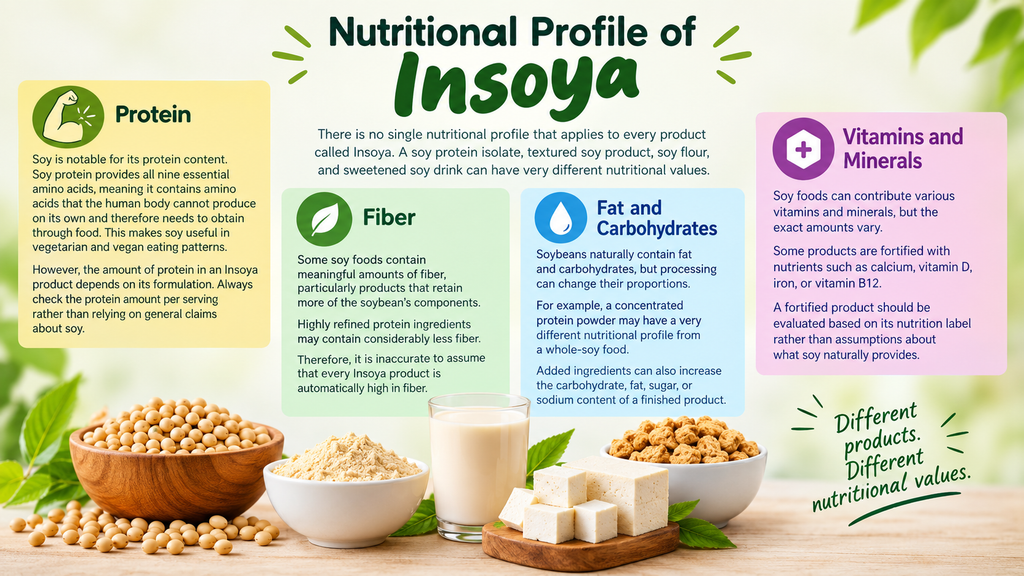
Nutritional Profile of Insoya
There is no single nutritional profile that applies to every product called Insoya.
A soy protein isolate, textured soy product, soy flour, and sweetened soy drink can have very different nutritional values.
Protein
Soy is notable for its protein content.
Soy protein provides all nine essential amino acids, meaning it contains amino acids that the human body cannot produce on its own and therefore needs to obtain through food.
This makes soy useful in vegetarian and vegan eating patterns.
However, the amount of protein in an Insoya product depends on its formulation. Always check the protein amount per serving rather than relying on general claims about soy.
Fiber
Some soy foods contain meaningful amounts of fiber, particularly products that retain more of the soybean’s components.
Highly refined protein ingredients may contain considerably less fiber.
Therefore, it is inaccurate to assume that every Insoya product is automatically high in fiber.
Fat and Carbohydrates
Soybeans naturally contain fat and carbohydrates, but processing can change their proportions.
For example, a concentrated protein powder may have a very different nutritional profile from a whole-soy food.
Added ingredients can also increase the carbohydrate, fat, sugar, or sodium content of a finished product.
Vitamins and Minerals
Soy foods can contribute various vitamins and minerals, but the exact amounts vary.
Some products are fortified with nutrients such as calcium, vitamin D, iron, or vitamin B12.
A fortified product should be evaluated based on its nutrition label rather than assumptions about what soy naturally provides.
Potential Benefits of Insoya
The potential benefits discussed below relate primarily to soy-based foods and products. They should not be interpreted as guaranteed effects from every product marketed as Insoya.
It Can Provide Plant-Based Protein
One of the main reasons people choose soy products is their protein content.
A soy-based food can make it easier to include protein in meals without relying on meat, poultry, or dairy.
For someone following a vegetarian or vegan eating pattern, soy can be one of several useful protein sources.
It Can Make Meat-Free Cooking Easier
Textured soy products are practical because they can be incorporated into familiar recipes.
Instead of learning an entirely new style of cooking, someone reducing meat consumption can modify existing dishes by replacing some or all of the meat with prepared soy.
This makes soy products particularly versatile for curries, sauces, wraps, stir-fries, and other strongly seasoned meals.
It May Fit a Heart-Conscious Eating Pattern
Many minimally processed soy foods are relatively low in saturated fat and contain no dietary cholesterol.
When such foods replace foods that are higher in saturated fat, they can fit into an overall heart-conscious dietary pattern.
However, the complete meal still matters. A soy product prepared with large amounts of salt, saturated fat, or highly processed ingredients should not automatically be considered a healthy choice simply because it is plant-based.
Protein May Support Fullness
Protein can contribute to feelings of fullness after eating.
A protein-containing meal may therefore be more satisfying than a meal that contains very little protein.
Some soy products also provide fiber, which can further contribute to a satisfying meal.
However, Insoya should not be considered a weight-loss product. Changes in body weight depend on overall energy intake, food choices, physical activity, portions, and many other factors.
It Can Add Variety to a Plant-Based Diet
A varied diet is generally more useful than depending on a single ingredient.
Soy can add another protein option alongside beans, lentils, peas, nuts, seeds, whole grains, and other foods.
Insoya and Digestion
Digestibility is one area where online descriptions of soy products can become misleading.
Different soy foods are processed differently, and people can respond to them differently.
Some individuals may tolerate tofu well but experience discomfort after consuming a large portion of another soy product. Others may have no noticeable digestive problems.
Gas or bloating can occur in some people after eating soy foods, particularly if their intake increases suddenly.
Preparation can also influence the eating experience. Dry textured soy products need to be properly hydrated and cooked before consumption.
Although fermentation can alter certain properties of soy foods, it should not be assumed that every product described as Insoya is fermented or automatically easier to digest.
Potential Side Effects and Limitations
Soy foods can be part of many people’s diets, but there are several considerations worth keeping in mind.
Soy Allergy
Soy is a recognized food allergen.
Anyone with a diagnosed soy allergy should avoid soy-containing products according to advice from their healthcare professional.
This is particularly important when purchasing processed foods because soy may appear in unexpected ingredients.
Gas and Bloating
Some people may experience gas, bloating, or other digestive discomfort after consuming soy.
If you are introducing a soy-based product into your diet, starting with a modest serving may make it easier to determine how you tolerate it.
Added Sodium, Sugar, or Other Ingredients
A product being plant-based does not automatically make it nutritionally ideal.
Flavored soy products, ready-to-drink beverages, protein mixes, and prepared meat alternatives may contain added sugar, sodium, oils, or other ingredients.
Reading the nutrition label can help you distinguish a relatively simple product from a highly formulated one.
Medication Considerations
People taking certain medications, including thyroid medication, should ask their doctor or pharmacist whether they need to consider the timing of soy foods around their medication.
This is particularly important because dietary factors can affect the absorption of some medicines.
Nutritional Balance
No single soy product should be treated as a complete diet.
Even a protein-rich food is best consumed as part of a varied eating pattern that includes vegetables, fruits, grains, legumes, nuts, seeds, and appropriate sources of fats and other nutrients.
How to Choose an Insoya Product
Since the name alone may not provide enough information, use the product label as your primary guide.
Check the Ingredient List
Look for the main soy ingredient and check for:
- Added sugar
- Oils
- Flavorings
- Preservatives
- Other allergens
- Sweeteners
- Additional protein sources
Check Protein Per Serving
Compare products based on the actual amount of protein they provide per serving.
A product with an attractive name may not necessarily contain as much protein as another soy product.
Check Fiber Content
If fiber is important to you, look at the nutrition panel.
Do not assume that every soy protein powder or processed soy product contains a substantial amount of fiber.
Check Fortification
If you are looking for vitamin B12, calcium, vitamin D, iron, or another nutrient, verify that the product actually contains it.
Check Serving Size
Serving sizes can vary significantly between products.
Comparing nutrition values is easier when you consider the serving size and, where appropriate, compare similar amounts between products.
Follow Preparation Instructions
Dry chunks, powders, flours, and drink mixes have different preparation requirements.
Following the manufacturer’s instructions can improve texture, taste, and usability.
Insoya Compared With Other Soy and Protein Foods
| Food or product | Main source | Typical form | Vegan | Key consideration |
| Insoya-type product | Soy | Varies | Product-dependent | Check the specific label |
| Soya chunks | Soy | Dry chunks or granules | Usually | Often rehydrated before cooking |
| Tofu | Soy | Soft to firm blocks | Usually | Made by coagulating soy milk |
| Tempeh | Soy | Firm fermented cake | Usually | Traditionally fermented |
| Whey protein | Milk | Powder | No | Dairy-derived protein |
| Pea protein | Peas | Powder | Usually | Soy-free plant protein option |
This comparison demonstrates why the specific product matters. The word Insoya does not automatically tell you whether the item is a powder, chunk, drink, or another soy-based food.
Is Insoya Suitable for Vegans?
A soy-based product can fit into a vegan diet, but the word Insoya alone does not guarantee that every product is vegan.
Some powders, drink mixes, flavored products, or prepared foods may contain milk-derived ingredients or other animal-derived components.
Before purchasing, check the complete ingredient list.
If vegan suitability is important, look for appropriate vegan labeling where available and pay particular attention to flavored or fortified products.
How to Add Insoya to a Balanced Diet
Adding a soy-based product to your diet does not need to be complicated.
Start by following the serving size and preparation instructions on the package.
For meals, you can combine textured soy with vegetables and grains to create a balanced dish. For example, soy chunks can be added to a vegetable curry alongside rice or another grain.
Soy protein powder can be used in a smoothie with fruit and other ingredients.
The broader goal should be dietary variety rather than relying on Insoya for every nutritional need.
Rotating between different protein sources such as beans, lentils, soy foods, peas, nuts, seeds, and other suitable foods can make a diet more varied.
What Should You Check Before Buying Insoya?
Before purchasing a product marketed as Insoya, consider this checklist:
- What is the main ingredient?
- How much protein does one serving contain?
- How much fiber does it provide?
- How much sodium does it contain?
- Does it contain added sugar?
- What type of fat does it contain?
- Is it fortified with vitamins or minerals?
- Does the product contain soy or other allergens?
- Is it actually fermented?
- Does it contain animal-derived ingredients?
- What is the recommended serving size?
- How should it be prepared and stored?
These details can tell you much more about the product than the name “Insoya” itself.
Final Thoughts
Insoya is best approached as a developing or loosely used term associated with soy-based foods and plant protein rather than as one universally standardized food with a single recipe.
Depending on the product, it may appear as chunks, granules, powder, flour, a drink mix, or another processed soy ingredient. Its protein, fiber, vitamins, minerals, calories, and other nutritional characteristics can therefore vary considerably.
Soy itself can be a useful part of a vegetarian or vegan diet because it provides plant-based protein and can be used in a wide variety of meals. However, claims that every Insoya product is fermented, probiotic, highly digestible, fortified, or nutritionally identical should be verified rather than assumed.
If you are considering Insoya, start with the label. Check the ingredients, nutrition facts, allergen information, serving size, preparation instructions, and any fortification claims.
Once you know exactly what a particular product contains, you can compare it with familiar options such as soya chunks, tofu, tempeh, soy protein powder, or pea protein and decide how it fits into your overall diet.


[…] Insoya: Uses, Benefits, Nutrition, and What to Know […]